






The AI CON by Dr. Emily M. Bender and Dr. Alex Hanna. Source.
by Brian Shilhavy
Health Impact News
The AI bubble and impending financial collapse is now being reported more than ever before.
And while the corporate media and even the alternative media are still participating in the AI Con with doomsday scenarios about computers becoming smarter than humans and “rogue AI agents” threatening our very existence, more and more people are drawing back the curtain and noticing that there is actually nothing there, and that most of what is being published in the media about AI is NOT real science, but simply science fiction.
At some point reality and the truth about AI will become evident to all, but will that time come before the entire economy of the U.S. is completely destroyed by what is being described as “The largest misallocation of capital in history“?
AI Fantasies Have Become a Dangerous CULT!
After I published my last update on AI, Is AI a Threat to “Destroy Humanity” or is the Real Threat Those Who Control the Technology?, I received several comments from a reader that probably totaled over 3000 words “explaining” to me how wrong I was to not fear AI, claiming supernatural evil powers were evolving from it.
And the kicker?
This commentor admitted that HE HAD NOT EVEN READ MY ARTICLE yet.
This is called “a Cult“, because it is a belief system that will withstand any amount of logic or truth you throw at it, because most of the time they will not even read or listen to anything that contradicts their belief system, and their “mission” to warn the world about the doomsday future ahead where AI takes over everything and replaces humans.
The AI CON
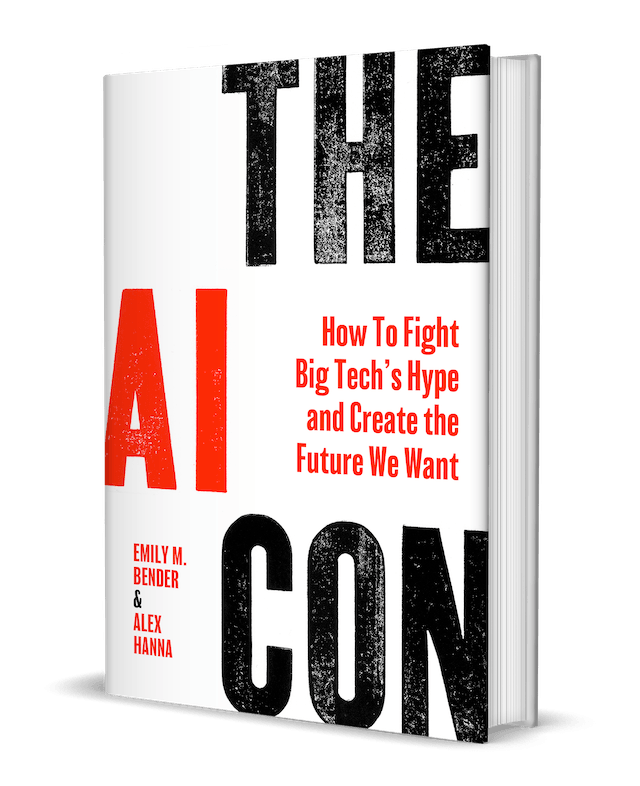
Let’s start with the AI Con first, which is what is fueling the AI Cult. The AI CON is the title of a new book that was co-authored by Dr. Emily Bender.
And while I have not read this book, I am very familiar with the work of Emily Bender. Like myself, Dr. Bender has a background in linguistics and technology, and is a Professor of Linguistics at the University of Washington where she is also the Faculty Director of the Computational Linguistics Master of Science program.
Dr. Bender co-authored an article that was recently published in The MIT Technology Review titled “Don’t be fooled by this summer of AI hype“.
Breathless claims about AGI and new capabilities fall apart pretty quickly under scrutiny.
Excerpts:
It’s been a busy few months for AI hype. At the end of April, Anthropic claimed that its model Claude Mythos is better at finding software vulnerabilities than most security experts. Then we had the OpenAI–Hugging Face hacking incident, after which Anthropic (proudly) and Meta (reluctantly) disclosed similar incidents involving their models.
This was followed by Anthropic’s claim that one of its models had made a mathematical breakthrough; soon OpenAI claimed a mathematical breakthrough of its own. Most recently, Anthropic engineer Jacob Coxon went viral announcing his departure from the company, claiming that it and OpenAI are “racing straight towards self-improving superintelligence and gambling with our lives.”
Each of these events was mostly covered breathlessly by the press, often repeating the companies’ anthropomorphizing framings—which are designed to portray their software is not only powerful but incipient “artificial general intelligence.”
So what is really going on? Are we witnessing a massive, civilization-changing set of technological breakthroughs, or is this marketing?
In all these incidents, massive fanfare from the companies (presented as mea culpas in illicit hacking cases) is accompanied by intense press coverage. Once there is time for experts in the relevant fields to examine what happened, a very different story emerges, but one that gets less media attention.
Regarding the “hacking” incidents, cybersecurity experts say the story is more about OpenAI’s negligence and failure to adopt basic, established security practices than about “models gone rogue” or “AI agents creating civilizations.”
As for the mathematical results, mathematicians who were initially “stunned” by OpenAI’s press release saying that its latest chatbot, Astra, solved problems that “have been open and seen no progress on the main result for at least a decade” later realized that the results weren’t as “novel as first appeared.”
Since then, mathematicians have accused the company of research misconduct and plagiarism, and they’ve reiterated that Astra didn’t make a “profound intellectual leap.” Just weeks later, OpenAI claimed its own mathematical breakthrough.
Two days before, Tristan Buckmaster, a math professor at New York University’s Courant Institute, published a bombshell statement suggesting that OpenAI had stolen other people’s work and improperly attributed it.
Claims of incipient, dangerous superintelligence are not based in good scientific or engineering practice. Rather, they are narratives based in ideologies of transhumanism, eugenics, and wishful thinking about imagined future digital humans.
Instead of OpenAI being prosecuted for creating malware that hacked another company, press releases, news outlets, media personalities, and lawmakers refer to “rogue models” as if they acted on their own.
Instead of researchers being questioned about their companies’ habit of plagiarizing academics’ work or using customer data to train models without consent, the public’s imagination is redirected to fears about what the future might hold upon the arrival of fictional superintelligent machines.
The AI Financial Apocalypse is now Widely being Reported
If you search beyond the AI hype and religious fever producing their click-bait “news” which everyone prefers reading about these days, you will find genuine fear and concern about where all this massive AI spending is leading us.
“Apocalyptic” is not really hyperbole when you drill down to the facts, instead of reading the hype.
It just isn’t making it into most of the corporate news feeds, because the facts don’t sell as well as the hype.
Here are some examples that you maybe missed from your news sources recently.
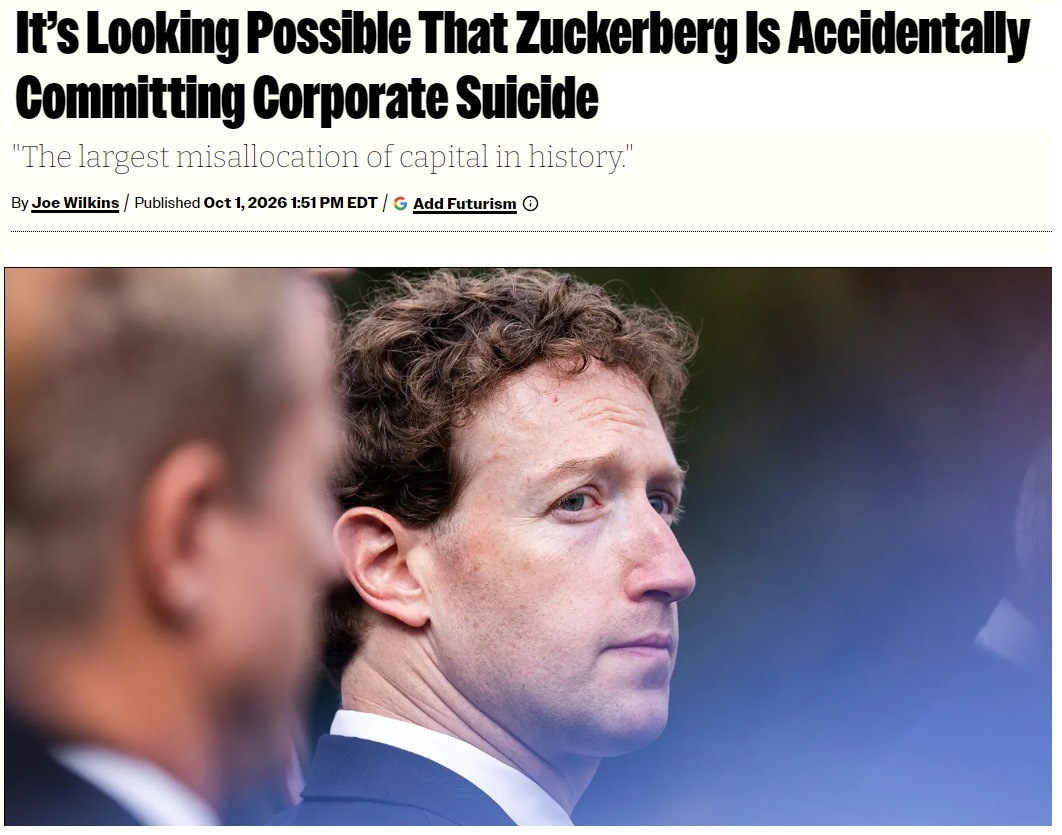
It’s Looking Possible That Zuckerberg Is Accidentally Committing Corporate Suicide
“The largest misallocation of capital in history.”
Excerpts:
Meta CEO Mark Zuckerberg has made the rash decision to double-down on massive AI spending, pushing a cutesy AI-mascot and poaching tech industry veteran Chirantan Desai to run a new division pushing Meta’s AI onto corporate customers.
The company’s investors, however, appear to be running out of slack for Zuckerberg’s leash. Since Friday of last week, a large sell-off in Meta stocks shrunk his paper fortune by nearly $20 billion, after Goldman Sachs began raising doubts about the long-term viability of the company’s AI ambitions.
It raises the question as to how much capital will be made available to satisfy the tech industry’s pie-in-the-sky AI push, and whether it can ever achieve revenue that would offset it.
In addition to Goldman Sachs’ gloomy outlook for Meta, hyperscalers as a whole face what appears to be an insurmountable challenge in turning AI into a profitable venture. As Bloomberg reported, the major management consulting firm Bain and Co recently penned an analysis finding that the AI industry will need to reach an annual revenue of $6 trillion by 2031 if tech leaders continue along their current spend-happy trajectory.
Doing so will require leaps in technological progress the likes of which are unprecedented in the information age — well beyond past innovations embodied by world-changing consumer tech like smartphones, for instance.
If we take the cynical path and assume that the AI industry won’t be able to pull off this miracle, then any major tech firm currently doubling down — like Zuckerberg’s Meta — will have functionally spent the better part of the 2020s rigging up their own corporate noose.
As finance professor at the University of Pennsylvania’s Wharton School Jessica Wachter penned in her own analysis of the AI financial bubble, if the promised money shower “fails to materialize,” then future historians will look back on this moment as the “largest misallocation of capital in history.”
And here’s another article from the latest The MIT Technology Review that does a deep dive into current AI spending, which also looks at Jessica Wachter’s analysis, and where this is probably leading us.
What’s at stake in AI’s trillion-dollar gamble
The AI hyperscalers will likely spend more than $1 trillion on data centers next year. Can they make enough money to sustain the infrastructure boom?
Excerpts:
When Jessica Wachter, a finance professor at the University of Pennsylvania’s Wharton School, wanted to assess AI’s impact on the economy over the next few years, she faced a long list of business and technical uncertainties. So she started with what she calls a “remarkable fact” that is not in question: A handful of so-called hyperscalers are investing huge amounts of money to build AI data centers.
Instead of trying to predict how useful and widely deployed AI models will be, she simply asked how fast the hyperscalers’ earnings will need to grow to justify their spending through 2027, when—she and her collaborator estimate—expenditures will reach nearly $1.1 trillion. It’s a no-nonsense accounting approach to making sense of today’s historical AI buildout.
The results are eye-opening: The AI companies will need to increase their own productivity by a factor of 2.7 to break even by 2030, accounting for the cost of capital, a 15% return, and depreciation of the assets.
If a productivity boom “fails to materialize,” she and her coauthor conclude in their research paper, “the current buildout will be the largest misallocation of capital in history.”
It doesn’t take superintelligence to realize that today’s large investments in the infrastructure for artificial intelligence come with huge risks. The hyperscalers will spend about $750 billion this year, building massive data centers scattered across the country.
And the spending spree shows no signs of slowing. According to some projections, total AI capital investments from the hyperscaler companies—Alphabet, Microsoft, Amazon, Meta, and Oracle (which partners with OpenAI)—could be more than $5 trillion over the next four years.
It’s one of the largest capital investments by any industry in history.
But there’s a problem that’s obvious to anyone paying attention.
While the hyperscalers plan to spend trillions, total AI revenues will be around $150 billion to $200 billion this year, says Gary Gensler, who ran the SEC during the Biden administration and is now a professor at MIT’s Sloan School.
“The challenge is that the spending does not have commensurate revenues yet. That’s a fact,” he says.
“And then the question is, is that an investment that will be paid off in the future?”
At stake in that trillion-dollar question is the financial health of the giant AI companies and the overall US economy—the investments could soon balloon to around 3% of GDP. The answer could also determine the fate of the hugely expensive data centers themselves.
The risks, both to investors and to the economy, have become even greater this year, as these AI companies have begun borrowing large amounts of money to build more and more data centers. Free cash flow—operating cash flow minus capital expenditures—is expected to soon dip into negative territory for the group.
Even Alphabet, known for generating and hoarding huge amounts of cash, reports in the latest quarter that its impressive revenues of nearly $120 billion were devoured by AI infrastructure spending, leaving it with a free cash deficit of some $5.9 billion—its first shortfall since Google went public in 2004.
Debt is expensive, and some investors are losing patience. If future demand for the data centers’ computation power drops, the companies will still be on the hook to pay back the borrowed money. What’s more, the risks are spreading to the rest of the economy as the loans get passed along via various financial mechanisms.
It won’t be enough to simply cover the enormous price tags of the new data centers. Hyperscalers will also have to pay for the rising costs of capital as they borrow more money.
They will need returns that are impressive enough to justify all their spending to investors and creditors. And to add to those concerns, they will have to make up for the depreciation of billions of dollars in chips housed within the facilities—a ticking time bomb buried in the investments.
Performance of the expensive GPU chips at the core of the data centers—such compute electronics represent some 60% of costs—is roughly doubling every two years or so.
Owners of AI data centers that come online this year and next will need to spend billions more on the next generation of chips by the end of the decade if they want to stay competitive.
Without the investments, says Mihir Kshirsagar at Princeton’s Center for Information Technology Policy, the data centers risk becoming “hulks,” stranded assets “scattered all over the place.”
To put it bluntly: The AI companies need to start making a lot more money. And they need to do it fast. But juicing their earnings alone still won’t be enough to sustain their data-center investments for the long term.
At some point, AI is also going to have to create broad economic growth to justify continuing the hyperscalers’ spending spree.
Sloan’s Gensler describes today’s large investments into AI infrastructure as “a parlay bet by the capital markets and the economy.” That means success will require winning three related but independent wagers: Hyperscalers must generate massive revenues, AI must boost widespread economic growth, and both must happen while the powerful but expensive so-called frontier models that rely on the data centers fend off cheaper versions, which many businesses might find good enough.
What makes this so tricky is that each wager depends on the other two but also poses its own challenges.
We’re all part of the AI gamble now
It was one thing when the AI companies were spending cash they had accumulated over the years to build their own data centers. Then the risk was largely limited to their own balance sheets and shareholders.
But it’s a higher-stakes game when much of the money is borrowed. Morgan Stanley, for one, calculates that more than half of the $2.9 trillion that hyperscalers will spend between 2025 and 2028 to build AI data centers will be financed with “external capital.”
The borrowing is leading some of the companies to engineer complex webs of financing that are becoming intertwined with much of the rest of the economy.
“A lot of financial institutions, directly or indirectly, are exposed to these data centers either as lenders, or as guarantors of some of the debt, or as backers of the private credit funds who are funding these data centers,” says Columbia’s Van Nieuwerburgh.
“People don’t even know they’re holding this stuff. It’s somewhere deep inside their pension fund. Ultimately, it’s backing their life insurance policies. And that risk is getting distributed everywhere in places that are invisible.”
As the investments in data centers have spiked, the financial engineering has become more byzantine.
Take, for example, Meta’s so-called Hyperion data center under construction in Richland, Louisiana. When the company announced the two gigawatts of compute capacity at a price tag of some $10 billion in late 2024 it was Meta’s largest planned data center.
Greeted with much enthusiasm by state and local politicians, the project, located in the rural northeast corner of the state, was seen as a boon to the community. Entergy Louisiana, the state’s largest utility, rushed forward with proposals to build three large natural-gas power plants to service the massive data center.
Then last fall—the projected cost was now $30 billion—the financing got a lot more complex and, to some in the community, a lot more disconcerting. Meta transferred an 80% stake to the large (and troubled) private-credit firm Blue Owl Capital, forming a joint venture called Beignet (like the famed New Orleans pastry) to raise financing for the data center.
Meta then signed a series of four-year leases with the joint venture, an arrangement that the company says gives it “long-term strategic flexibility.” To backstop the agreement, Meta provides the venture with what is called a residual value guarantee, in which it will make a cash payment to cover the value of the facility “following any non-renewal or termination of a lease.”
Got all that?
I hope so. The financial wheeling and dealing is actually even more convoluted, with a cast of wholly owned subsidiaries and LLCs. Beignet has set up Laidley LLC, which owns and operates the site as the landlord.
In turn, Laidley leases the facilities to Meta’s wholly owned subsidiary Pelican Leap LLC, which is the tenant. And there is a series of four-year leases that cover the different buildings that make up the data center campus.
It’s not a coincidence, says Van Nieuwerburgh, that the length of the leases matches the expected lifetime of the data center’s GPUs. While Meta has to pay off its loan if it terminates the leases early, that will still leave its investors
“with an empty building and no cash flow,” he says.
“And then they need to find a new tenant for a huge data center, and good luck with that.”
After the bubble
Predicting when the AI investment bubble will burst is a fool’s errand.
But there is little doubt a day of reckoning is coming, given the irrational exuberance that has overtaken the hyperscalers and their investors.
Of course, you might argue that this time is different, and that the rules of accounting and lessons of economic history don’t apply—that AI is too transformative.
Maybe, but don’t count on it.
Here are a few other articles from The Information (subscription needed to read the full articles) on AI finances that have been published recently showing the increasing debt to fund AI build-outs.
Cracks Emerge in AI’s Debt-Fueled Data Center Boom

Excerpts:
Bond markets are getting tough for lower-rated borrowers. One example: CleanSpark, which is developing a data center for Meta Platforms, had to offer investors big concessions to land financing earlier this month.
That deal is among the clearest signs yet that financing the data center boom is getting expensive across the board, and investors are getting picky about which new projects they’ll back. The bank loan market too is showing signs of strain, with some lenders like Société Générale, Sumitomo Mitsui Banking Corp. and Mitsubishi UFJ Financial Group becoming more selective in lending to data center projects, people arranging the deals say.
Those dynamics mean companies could struggle to borrow for planned data centers, jeopardizing growth plans for the broader AI industry.
Pressures on the AI financing market are coming from a number of different directions. Big data center operators like Amazon, Google and Microsoft will together spend some $700 billion on capital expenditures this year, and are expected to continue at around that level the next few years. They’ve issued nearly $160 billion in investment-grade debt this year, flooding the market with new supply.
That hyperscaler debt is getting more expensive relative to other highly rated corporate bonds, though the tech companies generate enormous operating cash flows. The extra yield investors are demanding to hold hyperscaler debt has risen by about 0.25 percentage points this year, compared with just 0.04 percentage points for the broader investment-grade market.
At the same time, several of these big tech companies are offloading spending onto other ventures raising money in the high-yield bond market. Meanwhile, developers building data centers for AI firms like Anthropic and OpenAI are leaning on the market too.
All told, the high-yield market has seen around $55 billion of AI-related bonds sold this year.
AI Risks, Macro Volatility Collide
Meanwhile, government bond yields are spiking, fueled in part by fears that persistently high inflation will prompt aggressive Federal Reserve interest rate hikes.
The AI boom itself is adding to the pressure—Fed Chair Kevin Warsh said last week that government yields have climbed in part because heavy tech debt issuance is crowding out investors.
AI Data Center Debt Is Showing Up Everywhere
Excerpts:
Debt financing for data centers and related infrastructure has grown rapidly enough that it’s become its own category these days—credit analysts are breaking out AI versus non–AI-linked debt across markets to analyze new issuance and performance. Several asset managers in recent months have filed to create exchange-traded funds focused on AI or AI infrastructure–related debt.
And right now, parts of this category aren’t doing so hot.
There’s a lot going on, from wider spreads on tech giants’ corporate debt in the investment-grade market; to investors demanding bigger concessions in recent bonds for AI data center projects in the high-yield market; to skittishness in the bank loan market for AI project financing. Investors are getting choosier and taking a harder look at project-specific construction and other risks.
Zeroing in on the high-yield market in particular, there’s a group of bonds that anyone with an interest in the AI build-out should be keeping an eye on. Overall, there have been at least 20 high-yield bond deals financing data center projects over the past 12 months.
The companies behind these projects, such as CleanSpark or TeraWulf, are hardly household names, and the project debt is often issued through even more obscure special purpose entities.
But if you do a little digging, many of the biggest names in AI show up connected to these data center projects in some form, as direct tenants, customers of the tenants or providing some kind of credit support to get the financing done. That means markets for lower-rated issuers are financing at least some of the infrastructure supporting the biggest AI companies.
Wall Street and Silicon Valley Split Over AI’s Price Tag

Excerpts:
Shifting economic forces are driving a widening divide between the financial views of Silicon Valley and Wall Street, clouding the outlook for trillions of dollars invested in AI.
Stock market angst has already caused delays for several medium-sized initial public offerings, and it is starting to cool once-red hot sentiment about Anthropic’s giant IPO, which is coming later in the year than investors expected.
While venture capitalists are still tripping over each other to invest at ever loftier valuations in AI startups showing any sign of traction, public market investors say they are retreating to big, safe stocks and growing skeptical about a flurry of data center companies trying to go public amid rising interest rates and high oil prices.
“Anything going public today needs to be priced right, and I don’t see it,” Samantha Lau, chief investment officer of small and mid-cap growth equities at asset management firm AllianceBernstein, referring to the IPO market overall.
“The only way to open the market is to be conservative.”
Leading AI companies like OpenAI and Anthropic will likely require a steady stream of financing, even after their IPOs, to help pay for their hundreds of billions of dollars worth of data center commitments.
Anthropic, for example, had committed to agreements for at least 14.8 gigawatts of compute capacity that could cost well over $500 billion over the next decade, The Information reported earlier this month. Data from Anthropic’s draft IPO prospectus reported this week by Reuters have renewed investor attention to the size of its financial commitments and other risks it faces.
‘Who’s Paying for It?’
Lau said that she is optimistic about agentic software capabilities that tech firms are demonstrating, showing new benefits to all the money invested in chips and data centers.
But it isn’t clear if investment firms would see a return on their investment, especially with rising interest rates that increase companies’ borrowing costs.
“The issue is, between here and the eventual utopia, who’s paying for it?” Lau added.
This article was written by Human Superior Intelligence (HSI)


See Also:
Understand the Times We are Currently Living Through
The Brain Myth: Your Intellect and Thoughts Originate in Your Heart, Not Your Brain

Is God’s Patience About to Run Out on the United States?

Second Edition of eBook Released: The Concept of the American Christian Family is a Myth and is NOT Found Anywhere in the Bible – by Brian Shilhavy

FREE eBook! Restoring the Foundation of New Testament Faith in Jesus Christ – by Brian Shilhavy

KABBALAH: The Anti-Christ Religion of Satan that Controls the World Today

Exposing the Christian Zionism Cult

The Bewitching of America with the Evil Eye and the Mark of the Beast

Jesus Christ’s Opposition to the Jewish State: Lessons for Today

Identifying the Luciferian Globalists Implementing the New World Order – Who are the “Jews”?

The Seal and Mark of God is Far More Important than the “Mark of the Beast” – Are You Prepared for What’s Coming?

The Satanic Roots to Modern Medicine – The Image of the Beast?

Medicine: Idolatry in the Twenty First Century – 10-Year-Old Article More Relevant Today than the Day it was Written


Having problems receiving our emails? See:

How to Beat Internet Censorship and Create Your Own Newsfeed
We Are Now on Telegram. Video channels at Bitchute, and Odysee.
If our website is seized and shut down, find us on Telegram, as well as Bitchute and Odysee for further instructions about where to find us.
If you use the TOR Onion browser, here are the links and corresponding URLs to use in the TOR browser to find us on the Dark Web: Health Impact News, Vaccine Impact, Medical Kidnap, Created4Health, CoconutOil.com.
One Comment