





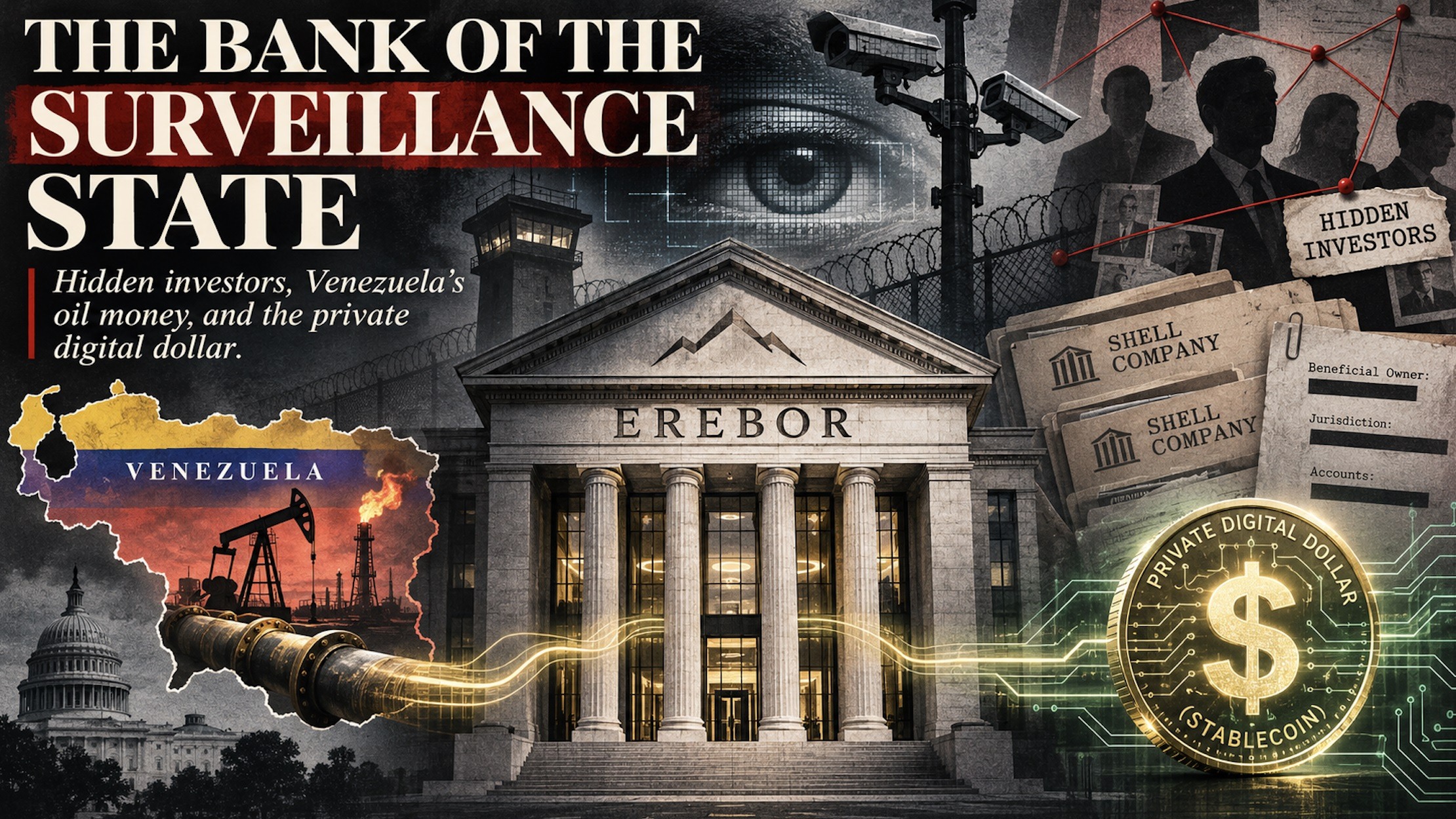
When the same men control both the money and the watching, a digital dollar can arrive without Congress ever voting on one, and in this case a private company would hold it. – The Leah Files
Comments by Brian Shilhavy
Health Impact News
The first U.S. federally chartered bank to deal in cryptocurrencies was formed earlier this year, in Venezuela.
While this did not make it into the news feeds of the corporate media, Leah of The Leah Files has just done a deep dive into this new U.S. bank operating in Venezuela, claiming that it is the first bank dealing with private digital dollars that is being tested in Venezuela.
The name of the bank is Erebor, but most of its investors are hidden from the public.
Continuing with her series on the Epstein Digital Financial System being built here in the U.S., Leah unmasks many of the players linked to this first-of-its-kind private digital bank.
Her investigative path leads to Peter Thiel’s Founders Fund, and two tech companies serving the military and its spy agencies, Palantir and Anduril.
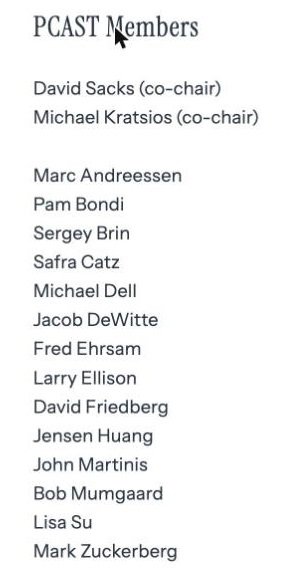
Her path also leads to the President’s Council of Advisors on Science and Technology, with Tech heavyweights and other notable Trump allies such as Pam Bondi, Sergy Bin, Michael Dell, Larry Ellison, Mark Zuckerberg, and the recently disgraced but now restored Jensen Huang of Nvidia.
Leah’s trail to this new bank also leads to one of Jeffrey Epstein’s financial advisors, who is called the “Female Warren Buffet”, and her name appears 1,622 times in the Epstein files.
THE SURVEILLANCE STATE NOW HAS A BANK, AND IT IS HANDLING VENEZUELA’S OIL MONEY
The men who built the border and police tech are building a private digital dollar, Venezuela is where they are testing it, and the bank in the middle hides who owns it.
by Leah
The Leah Files
Excerpts:
On November 18, Secretary of War Pete Hegseth landed in Caracas and announced a deal to restore military ties with Venezuela.
The other thing happening in that country got far less attention, which is that a bank in Columbus, Ohio that opened in February has signed a correspondent banking agreement with Venezuela’s largest state bank and is advising on a $5 billion loan from the same Pentagon office that holds the government’s 35% stake in Venezuela’s oil.
The bank was started by the same men who are building America’s surveillance state.
That bank is Erebor. Palmer Luckey, who runs Anduril and builds the border towers, started it with Joe Lonsdale, who co-founded Palantir and stitches government databases together, and Peter Thiel’s Founders Fund paid for the start.
Those men now hold a federally chartered bank that the Financial Times reported in October holds more than $7 billion in deposits. If you have read my work on the dollar, you know where this leads, because a bank like this is the plumbing for a private digital dollar, and the Treasury has been building the legal path for one all year.
What I found when I lined up the SEC filings, the UK company records and the campaign finance data is that the people who own this bank are hidden.
Erebor’s ownership has been split across 39 shell funds that report $116 million from 858 investor positions without naming a single investor, and when I traced the names that do surface, they lead to a Russian family in Monaco whose London partnership runs a shell that put $5.15 million into the bank sixteen days after the son’s business partner signed for a Venezuelan oil field at Miraflores Palace, and to Jeffrey Epstein’s former publicist, who sold stakes in the bank through her venture fund. I think the structure was built so that nobody can see who gets paid when Venezuela’s oil money starts moving through it.
The timing makes that harder to dismiss. Investors started buying into this bank six weeks after it applied for a charter and three months before the Comptroller approved the charter, and the people who bought early have watched the reported value more than quadruple.
HOW THE SURVEILLANCE STATE ENDED UP WITH A BANK
If you read How the U.S. Turned Venezuela’s Oil Money Into a Payday for Insiders, you heard me mention Erebor. Its co-founder, Jacob Hirshman, was the only American bank executive on the attendee list for Interior Secretary Doug Burgum’s breakfast in Caracas in March, according to Bloomberg, and over the next two months he kept going back.
He offered Erebor’s services to Luis Pérez, the interim head of Venezuela’s central bank, and to the country’s private banks, proposing to open correspondent lines and sub-accounts that would reconnect them to American banks, and one person told Bloomberg that he said the bank had the backing of the U.S. government.
On May 20, Banco de Venezuela signed a correspondent agreement with Erebor. The bank is also advising the AI company Fluidstack on its application for a $5 billion loan from the Office of Strategic Capital, the Pentagon office that holds the government’s 35% stake in the Venezuelan oil venture.
Anduril, Palantir and Founders Fund are the spine of The Names Behind America’s Surveillance State, and Erebor is where their money and their government contracts finally meet a bank charter. Hegseth’s trip to Caracas is what moved Erebor from a mention in that article to the subject of this one.
HOW A BANK HIDES ITS OWNERS
Erebor’s public investor list is about a dozen venture firms, and it tells you very little about who owns the bank.
I pulled every Form D with Erebor or its nickname, ERBR, in the title, and I count 39 of them. Together they report $116,203,709 from 858 investor positions. One pair, called Friends of Erebor, took $19,954,675 from 312 people in an offering that opened on a single day with a $1,000 minimum, and nothing in the filing says who those 312 people are.
Bank regulators generally vet anyone who owns 10% or more of a bank, and an investor who stays under that line never has to be named.
That is why I treat a bank whose ownership is split into dozens of small stakes as a place to look closely.
THE RUSSIAN IN MONACO
The money I can trace most clearly is $5,154,639 that went into a Delaware shell called KOSH ERBR Sep 2026 on September 18, 2026, the same week Erebor was selling stock in a round reported at a $9.5 billion valuation. The SEC filing reports a single investor, it is signed by Nikolay Koshikov as manager, and the only related party it names is KOFF Investments LLP, a partnership on the third floor of 207 Regent Street in London.
Companies House shows that KOFF is controlled by Oleg Koshikov, a Russian citizen born in December 1964 who lives in Monaco and holds at least 75% of the voting rights, and I believe he is Nikolay’s father.
The partnership has three members, who are Oleg, Nikolay, who joined in December 2021, and Lafayette Management, a company in Nyon, Switzerland that has also served as a member of two other London partnerships that have since been dissolved. A company formation agent in Watford filed the paperwork that created KOFF on June 7, 2021.
The partnership’s accounts show a vehicle with almost nothing in it. It reported no assets and no income through June 2023, and in the following year it paid a £812,810 deposit toward an investment that was financed by a long-term loan of the same amount.
Its accounts for the year ended June 30, 2025 show £16,970 in the bank, £32,000 of capital put in by Oleg, who absorbs 98% of the losses, and a single investment of £812,810 in unlisted equity that is matched by a loan of exactly £812,810 from a lender the filing does not name.
A partnership with that balance sheet did not produce $5.15 million from its operations, so I think the single investor in KOSH ERBR is the Koshikov family and that the money came from somewhere the British filings do not show, and the lender behind the £812,810 is the first place to look for who is financing the family’s American bets.
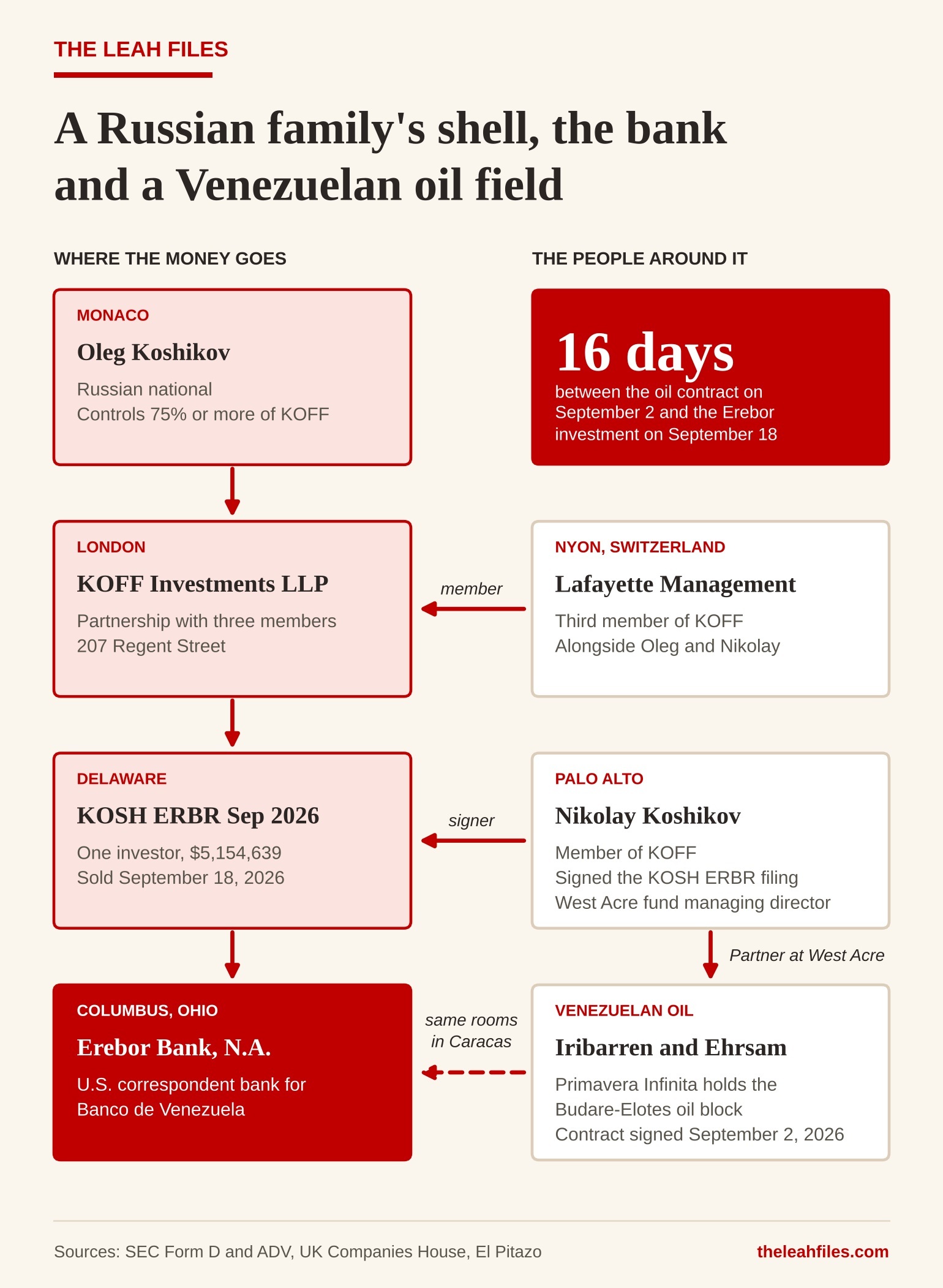
Nikolay is the way in. He is 30, he was president of the Oxford Union in early 2017, and the SEC filing for West Acre Capital Fund I names him and Manuel Iribarren as the two managing directors of the fund’s general partner.
West Acre is a venture firm that sold $54.3 million of that fund in 2024 and lists a house on Kipling Street in Palo Alto as its office.
The firm’s adviser filing from May 2026 shows Iribarren as the majority owner of West Acre and of the fund’s general partner, and it lists a second managing director, Jeremy Barenholtz, who arrived in December 2024 and holds the next largest stake.
Nikolay Koshikov does not appear on that filing. It reports 35 investors and $99.4 million in assets, with 29% of the fund held by other funds and 7% by investors outside the United States.
The partner who got the oil field
Manuel Iribarren is a Venezuelan in his late twenties who was raised in the United Kingdom, studied product design at Stanford and spent his early career teaching design thinking to schoolchildren.
Primavera Infinita LLC was registered in Delaware on February 13, 2026, the same month Venezuela’s oil ministry suspended the contract of the company that had been running the Budare-Elotes oil block. On September 2, 2026, Iribarren signed for Primavera at Miraflores Palace in Caracas, at a ceremony led by interim President Delcy Rodríguez and U.S. Energy Secretary Chris Wright, and the contract gave Budare-Elotes to a company that was less than seven months old.
Iribarren’s co-founder at Primavera is Fred Ehrsam, the billionaire who co-founded Coinbase and the crypto fund Paradigm, and whom President Trump named to his Council of Advisors on Science and Technology on March 25.
Marc Andreessen, whose firm is an Erebor investor, sits on the same council. West Acre is tied to Ehrsam as well, because the fund backed his brain-device startup Nudge and Iribarren has described working alongside him there.
Primavera’s short-term goal is 100,000 barrels a day, it has hired three former Chevron Venezuela executives, and its head of security, Michael Jensen, most recently served on the National Security Council. Bloomberg reported on September 1 that Ehrsam was also seeking three more fields in the Orinoco Belt.
Sixteen days after that signing, on September 18, the shell managed by the Koshikov partnership put its $5,154,639 into Erebor. One of West Acre’s two founding managing directors signed for a Venezuelan oil field, and the other signed the paperwork for a stake in the American bank that had already become Banco de Venezuela’s correspondent in the United States.
The same rooms in Caracas
Ehrsam and Erebor have been working the same rooms all year. When Interior Secretary Doug Burgum met executives and investors in Caracas in March, Ehrsam was in the group and so was Erebor co-founder Jacob Hirshman.
On May 13, Ehrsam spoke at a Banco de Venezuela event led by the bank’s president, Román Maniglia, where he pitched stablecoins and the tokenization of assets as the future of Venezuelan banking.
Seven days later, Banco de Venezuela signed its correspondent agreement with Erebor. Ehrsam was also an early investor in Anduril, the company Erebor co-founder Palmer Luckey runs, according to the Venezuelan outlet El Pitazo.
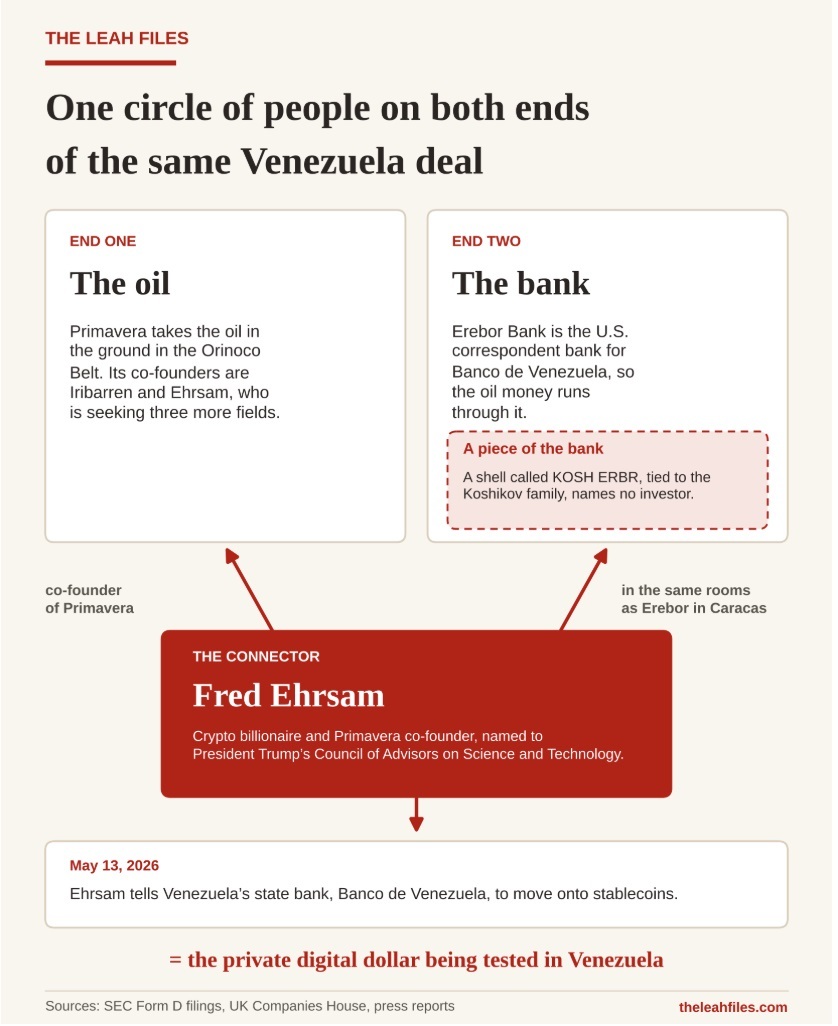
I think this is one circle of people working both ends of the same deal.
One end takes the oil in the ground through Primavera, the other end takes a piece of the bank that the oil money will run through, and a crypto billionaire who advises the President connects the two while he pitches Venezuela’s state bank on moving to stablecoins.
That is the private digital dollar being tested in Venezuela, and I believe the Koshikov family holds a stake in it through a shell that names no investor.
An earlier shell called KOSH EREBOR I, run through the same Delaware platform, took $12.5 million from 27 investors on October 30, 2025, fifteen days after Erebor won its conditional approval, and I think KOSH stands for Koshikov.
That date is two months before U.S. forces removed Nicolás Maduro on January 3, 2026, and more than three months before Primavera existed, which means this circle was gathering money for the bank before there was any public deal for Venezuela’s oil.
Russian family money has turned up in Erebor’s circle before.
Joe Lonsdale, who co-founded Erebor, has employed the sons of two sanctioned Russian oligarchs at his firm 8VC, Denis Aven and Jack Moshkovich, according to a 2024 Forbes investigation. Oleg Koshikov is not on the Treasury sanctions list, and a structure like this one lets a wealthy Russian’s money reach an American bank without anyone in Washington having to learn his name.
So a Russian national in Monaco controls a London partnership, built with a Swiss corporate member, that manages a Delaware shell holding $5.15 million of a federally chartered bank in Columbus, Ohio, and that bank is the U.S. correspondent for Banco de Venezuela, while his son’s business partner holds a Venezuelan oil field under a contract signed in front of a U.S. cabinet secretary.
“YOUR FEMALE WARREN BUFFET”

Masha Drokova/Bucher. Image source. Added by editor – not in original article.
In early 2018 a young Russian publicist in San Francisco emailed Jeffrey Epstein a link announcing her new venture fund. In another email that spring she signed off as “Your female Warren Buffet.”
Her name then was Masha Drokova.
Before she came to the United States she was a spokesperson for Nashi, the pro-Kremlin youth movement, and there is a documentary about her called Putin’s Kiss.
She worked as Epstein’s publicist from 2017 until his arrest in 2019. She goes by Masha Bucher now, her fund is Day One Ventures, and her name appears 1,622 times in the Epstein files the Justice Department released this year.
One of those documents is a 2020 FBI report in which a confidential source says Day One was in Silicon Valley to steal technology. Bucher says Epstein never invested in Day One, and that she turned to him because she was under threat from Russia.
On September 16, 2026, a shell called ERBRNA 2026 began selling stakes in Erebor. It raised $3,435,000 from 27 investors.
The SEC form is signed by Mariia Bucher for Day One Ventures.
Day One was also one of the first investors in a nuclear reactor startup called Valar Atomics. Palmer Luckey put money in later. On August 4, Valar announced a $200 million credit line led by Erebor. Two months later Valar sued Day One in Delaware over who gets to buy into the next round, and the two sides spent October fighting about it on X.
So Epstein’s former publicist owns part of a company that borrows from Luckey’s bank, is being sued by that company, and is selling pieces of Luckey’s bank to 27 people.
If you read The New US Dollar: The One Epstein Built, you know I think Epstein’s fingerprints are all over the early stablecoin business. His estate still holds about $170 million in Valar Ventures, a Thiel firm.
Valar Ventures backs a stablecoin payments company called Yellow Card. Yellow Card banks with Erebor.
WHAT THIS ALL MEANS
A bank is different from every other company these funds sell, because it sees everything, including who paid you and who you paid.
Erebor told regulators it wants to be the most regulated entity handling stablecoin transactions, which is a polite way of saying it wants to be where the digital dollar lives. Its founders already sell the government the tools that watch the border and tie its databases together.
When the same men control both the money and the watching, a digital dollar can arrive without Congress ever voting on one, and in this case a private company would hold it.
Erebor’s deposits are FDIC insured, and on June 30, $2.05 billion of its $4.06 billion in deposits had been placed there by brokers. At that point the bank had lent out $77 million and held $4.17 billion in cash and balances at other banks, so what it mostly does so far is hold deposits, and the public cannot see who owns it.
Deciding which countries get dollars is supposed to be the government’s job, yet in Venezuela a private bank is standing at the door, and Syria looks like the next one because Hirshman has already been there.
When a sanction comes off, a bank that already holds the correspondent relationship is positioned to earn fees on the money that starts to move.
The filings name none of the 858 investors, and I think that is the reason the names are hidden, because anyone among them who helps decide which sanctions come off would never have to say so.
The one tool built to answer this question is gone now.
Congress passed a law making shell companies tell the Treasury who owns them. On August 11, 2026, the Treasury’s financial crimes bureau finished killing that requirement for American companies and announced it would delete what their owners had already filed. A former acting head of that bureau, Michael Mosier, is on Erebor’s board.
Venezuela is the dry run. If a country’s oil money, banks and currency can be rerouted through a bank like this one without anyone asking who owns it, I don’t see why it stops there.
Read the entire article at The Leah Files.
Related:
The Epstein Digital Financial System is Getting Ready to Replace the U.S. Dollar
This article was written by Human Superior Intelligence (HSI)

See Also:
Understand the Times We are Currently Living Through
Who Are “the Jews”, According to the Bible?

The Brain Myth: Your Intellect and Thoughts Originate in Your Heart, Not Your Brain

Second Edition of eBook Released: The Concept of the American Christian Family is a Myth and is NOT Found Anywhere in the Bible – by Brian Shilhavy

FREE eBook! Restoring the Foundation of New Testament Faith in Jesus Christ – by Brian Shilhavy

KABBALAH: The Anti-Christ Religion of Satan that Controls the World Today

Exposing the Christian Zionism Cult

The Bewitching of America with the Evil Eye and the Mark of the Beast
Jesus Christ’s Opposition to the Jewish State: Lessons for Today

Identifying the Luciferian Globalists Implementing the New World Order – Who are the “Jews”?

The Seal and Mark of God is Far More Important than the “Mark of the Beast” – Are You Prepared for What’s Coming?
The Satanic Roots to Modern Medicine – The Image of the Beast?

Medicine: Idolatry in the Twenty First Century – 10-Year-Old Article More Relevant Today than the Day it was Written

Having problems receiving our emails? See:
How to Beat Internet Censorship and Create Your Own Newsfeed
We Are Now on Telegram. Video channels at Bitchute, and Odysee.
If our website is seized and shut down, find us on Telegram, as well as Bitchute and Odysee for further instructions about where to find us.
If you use the TOR Onion browser, here are the links and corresponding URLs to use in the TOR browser to find us on the Dark Web: Health Impact News, Vaccine Impact, Medical Kidnap, Created4Health, CoconutOil.com.
Leave A Comment