

Image source [1].
by Brian Shilhavy
Health Impact News
I have been warning the public about the AI technology bubble since the last quarter of 2022, when the first AI chat bot, ChatGPT, was released to the public and became the most downloaded app of all time.
And while there almost was a crash in the first quarter of 2023 when many of Silicon Valley’s largest banks collapsed, the U.S. Government stepped in and bailed them out.
The main reason why the crash has not happened yet, is because most of the largest technology companies such as Google, Microsoft, Amazon.com, etc., all had huge cash reserves to fund their investments into AI in the beginning.
Fast forward to today as we end the second quarter of 2026, and almost ALL of those cash reserves have been spent, and most of these technology companies are taking on debt through corporate bond sales, because they are too afraid of being “left behind” in the great AI race, which is a race to nowhere, and will end very badly, for all of us.
While I have been a mostly dissenting voice in the alternative media sounding the alarms against AI spending for the past three and a half years, I am no longer.
After three straight days of losses on the NASDAQ including huge losses on Monday and Tuesday this week for the Big Tech companies, I would estimate that about 90% of the corporate news financial analysts are talking about an AI crash now, and much of it is not even speculative, but treating it as a certainty.
Here are some of those articles being published now.
From the Financial Times [2]:
Everything is AI
A Nightmare on LLM Street
by Financial Times [2]:
Excerpts:
“Technology” was always a nonsensical investment category. With each passing year, it becomes even less sensical.
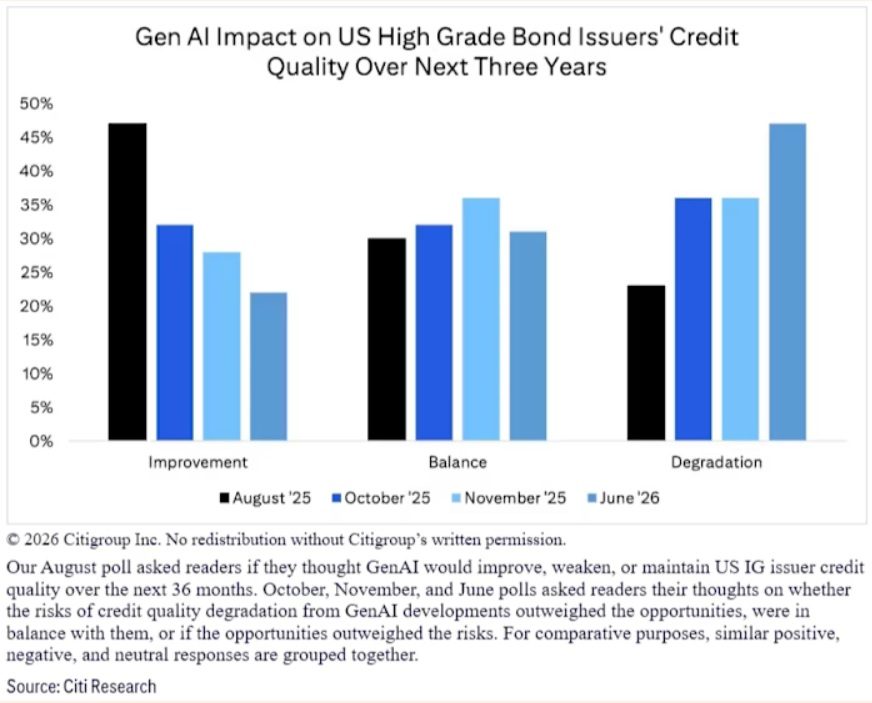
AI (because it can mean anything and nothing) has been adding new layers of complication to the category. Citigroup credit analyst Daniel Sorid writes:
Sector labels are losing their power to describe AI risk as the buildout’s footprint expands, with at least 40 per cent of [investment grade debt] carrying a revenue link to AI, by our estimate. Non-Tech issuers improving fundamentals on AI revenue are growing dependent on the buildout’s continuation, leaving index holders with embedded AI exposure well beyond their Tech allocation.
Increasingly, debt is where everyone’s looking for signs of a bubble bursting. US investment-grade tech companies have issued $362bn since August, per Citi’s numbers, as hyperscalers rushed to borrow.
As a result, the hyperscalers’ share of the tech investment-grade universe has grown to 40 per cent by face value, from 28 per cent in August.
Their uncertain returns on investment and accelerating levels of downstream disruption have caused investor sentiment to flip negative over the past year:
New issuance means that, by the official taxonomy, the tech sector now accounts for about 11.5 per cent of US investment grade, having held steady at around nine per cent for most of the previous decade.
From NPR’s All Things Considered [3]:
Is AI ‘one big bubble’? Behind the tech sell-off
by NPR [3]
Excerpts:
A wave of selling in tech stocks is starting to reflect doubts over whether the spending boom on artificial intelligence is worth it.
The best-known AI-related tech stocks, Nvidia and Google-parent Alphabet, were down for a second day in a row.
Among the biggest losers on Tuesday, however, was chipmaker Micron Technology, whose shares plummeted over 13%. These sell-offs sent the tech-heavy Nasdaq index down over 2%.
Micron’s stock is the perfect representation of what’s going on in the stock market. It has skyrocketed in value in the past year — up close to 800% — on soaring demand for memory chips from the AI build-out, showcasing the massive valuations for AI-related stocks.
Over $1 trillion spent. “Are we going to start to see returns?”
Spending on AI has been monumental. According to Stanford University’s AI Index Report, there was more than $580 billion in corporate investment into AI in the past year across the globe, on top of over $1 trillion in the four preceding years.
These doubts have led to jitters in the stock market. On Monday, Alphabet stock fell 5%, and SpaceX dropped 16%.
That nervousness spilled over into markets in Asia. Korean markets were the worst hit after stocks of Samsung and its competitor SK Hynix fell 12% apiece.
From The Hill [4]:
The AI bubble could be worse than the dot-com bust
Excerpts:
A growing chorus of analysts are beginning to question the sustainability of current market valuations, arguing that a reality check may be overdue.
Concerns about speculative excess have grown amid heightened enthusiasm, and potential risks, surrounding the SpaceX IPO, where an initial offering price of $135 per share valued the Elon Musk-led company at over $1.75 trillion, as well as the forthcoming mega-IPOs of two leading AI firms, Anthropic and OpenAI.
Analyst forecasts indicate that Alphabet, Amazon, Meta Platforms, Microsoft, and Oracle (the so-called hyperscalers) will spend around $755 billion on AI-related capital expenditures in 2026. So far this year, strong earnings growth has provided the impetus for the parabolic spike in some stock prices.
However, extrapolating from recent robust growth in semiconductor and memory chip revenues and expecting sustained long-term outperformance is risky, as it relies on the uncertain assumption that the current boom in AI infrastructure spending will continue unabated. Major hyperscalers are already resorting to additional debt and equity financing to support their elevated capital expenditures, since even their substantial free cash flow is becoming insufficient to fund the escalating investments needed for AI infrastructure.
The current stock market boom and the American economic performance is being fueled by a self-reinforcing cycle. Gains in a handful of AI-focused stocks are enabling major tech firms to invest heavily in the infrastructure that investors expect will drive future growth. This spending boosts GDP both directly, through massive capital investment, and indirectly, through the increased purchasing power of the wealthiest individuals.
But with both the broader economy and the ongoing bull market relying heavily on a concentrated AI-driven boom, the fallout from a burst bubble could be severe.
There is increasing urgency around assessing whether the AI-driven stock market rally of recent years has evolved into a full-fledged equity bubble. Insights from previous technology-fueled bubbles can provide useful perspective and help contextualize current fears regarding the emergence of an AI bubble.
From Barrons [5]:
Palantir Stock on Pace for Worst Month in 5 Years
Excerpts:
A bad year for Palantir Technologies stock keeps getting worse, with shares set to log their worst monthly decline in five years after breaking below a key level of support on Monday.
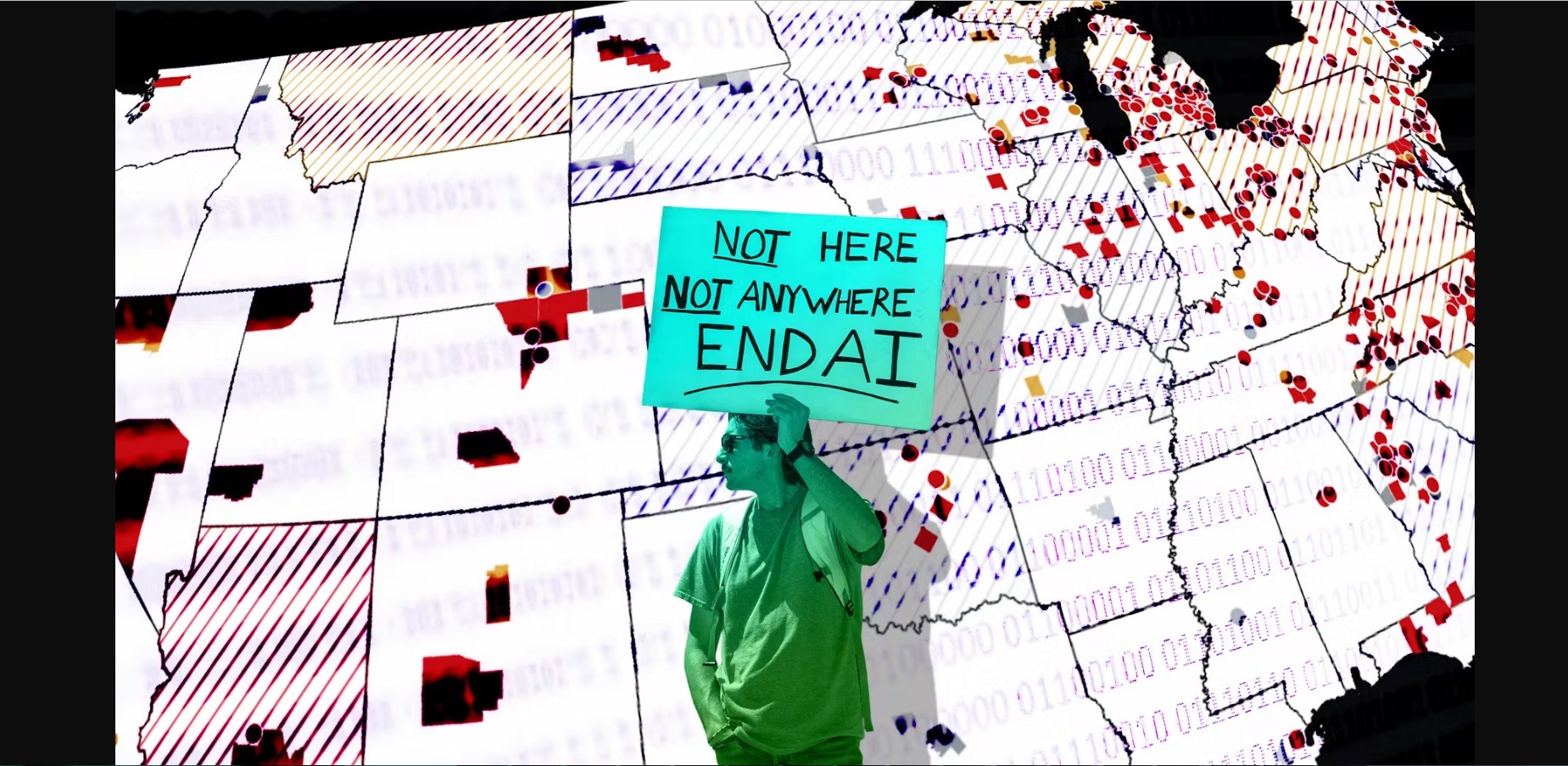
Image Source [6].
Much of the debt these technology companies are taking on is for the construction of new massive data centers. But public opposition to these data centers is growing.
From The Information [6]:
The 300-Plus Bans and Moratoriums Threatening the U.S. Data Center Boom
Excerpts:
Since the start of the year, cities, towns, counties and states across America have slammed the brakes on allowing new data centers in their backyards.
By exhaustively combing through a combination of legal documents and local news reports, The Information has identified more than 300 temporary and permanent bans on data center development that state and local governments throughout the U.S. have passed since 2023, and over 75 more under consideration.
The vast majority of those temporary or permanent bans have been enacted this year: More than 275 have passed since Jan. 1 and 150 plus since the start of May.
Charts above and below show the location of those moratoriums—and their explosion in popularity over time.
Elon Musk’s Criminal Fraud
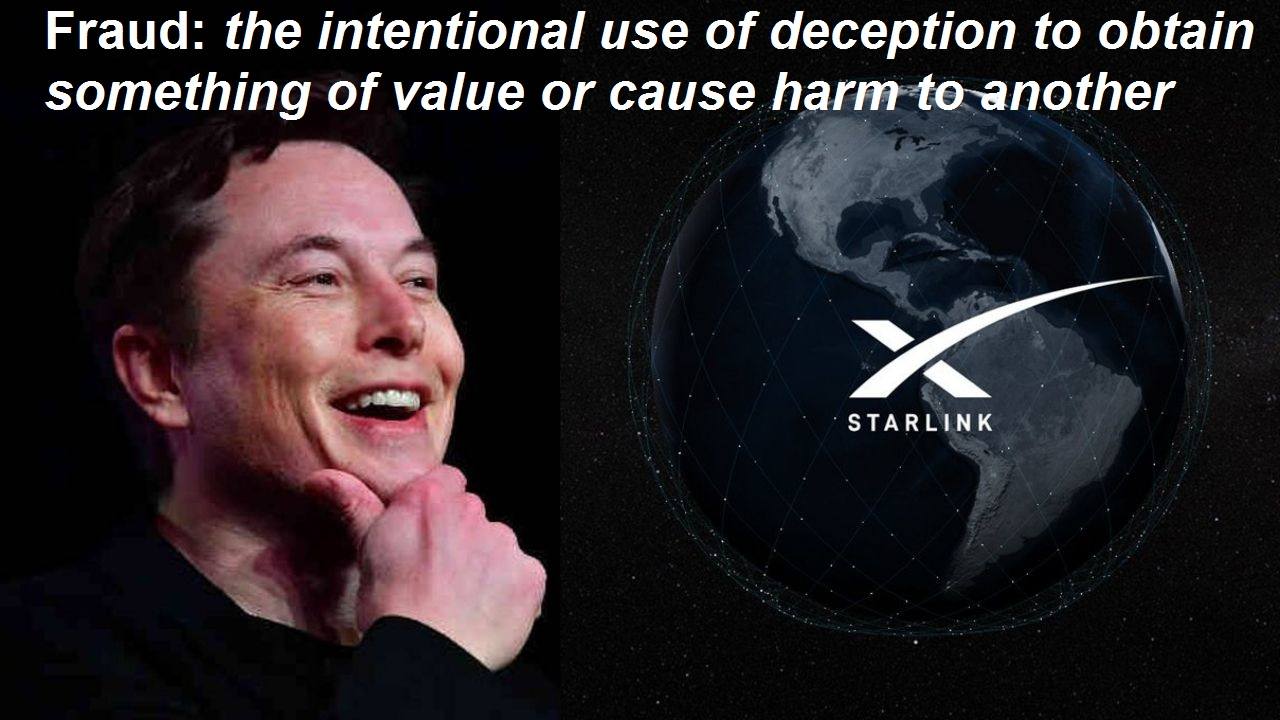
Earlier this month (June, 2026), I warned the public about Elon Musk’s company SpaceX and the largest IPO in the history of America, and how it would bankrupt America:
Big Tech is Rushing to Bankrupt America – Investing in a Science Fiction View of the Future is Going to End and We will All Suffer [7]
Excerpts:
With new IPOs coming up for Musk’s SpaceX and for Sam Altman’s OpenAI, Wall Street, which is increasingly becoming less tech savvy and just investing in hype, is going to take the next step in bankrupting America.
Haven’t people learned from Elon Musk’s constant lies for the past two decades?
Where are his fully autonomous driverless taxis? Where are the $35K human robots that he promised would be in everyone’s homes by now?
It’s all BS! But people keep feeding it, too scared to be left behind.
Now the biggest IPO in the nation’s history is set to happen next week for SpaceX.
Is SpaceX rolling in the cash with record sales? Nope. It is actually losing money.
So why will Wall Street groupies invest?
Because Musk promised them there would be floating data centers in space to fuel the expansion of AI, in the future.
Everyone and anyone who is investing in Musk is continuing to invest in the future, for a version of science fiction which will never happen.
And because Musk is also behind removing regulations to protect American’s retirement accounts from such risky investments, within the next few weeks a majority of Americans’ retirement accounts may be left holding the bill for these mammoth Big Tech IPOs, whether they want to or not.
They say Rome did not fall in one day, but America just might.
Full article. [7]
Elon Musk briefly became the world’s fist trillionaire just after SpaceX joined the NASDAQ, but $billions have now been wiped out of SpaceX stocks, and it has now been announced that SpaceX will also take on debt of around $20 billion.
Musk loses trillionaire status as SpaceX shares ‘come down to earth with a bump’
by The Guardian [8]
Excerpts:
Musk’s fall back into the ranks of the billionaires follows a fall in SpaceX’s shares over the last week, after the initial jump in its value when it floated on the stock market two weeks ago faded.
SpaceX sold shares to investors at $135 each in its initial public offering. They jumped as high as $176 on 12 June, the first day of trading – making Musk the world’s first trillionaire – and hit a peak of $225 on 16 June. But they then slipped back to $156 last night, after a 16% plunge on Monday.
Today, SpaceX’s shares are down 1.35% in early trading at $154.00.
Susannah Streeter, chief investment strategist at Wealth Club, says:
SpaceX has come down to earth with a bump, burning off most of its post-launch steam.
The sell-off may have been partly triggered by the confirmation that it was planning a bond sale, expected to be around $20 billion. Issuing debt at such a heady valuation raises questions about cash flow for this hugely capital-intensive venture.
As well as his roughly 40% stake in SpaceX, Musk also owns around 12% of Tesla.
And more bad news for Tesla today with another accident reported that killed a woman while the Tesla was allegedly on “automated driving assistance”.
Victim’s family in fatal Texas Tesla ‘automated driving assistance’ crash files lawsuit
Attorneys for Martha Avila’s family said the Tesla was in “Autopilot” mode when the speeding car crashed into the 76-year-old woman’s home, killing her.
Excerpts:
The family of a woman who was killed when a Tesla in an automated assist mode crashed into her Houston-area home has sued Tesla and the person behind the wheel, attorneys said Tuesday.
The suit, filed by 76-year-old Martha Avila’s daughter Jennifer Barbour and her husband, Justin Barbour, in Harris County District Court, alleges a “design defect” involving Tesla and a failure to warn. It alleges negligence against both Tesla and the driver, Michael Butler.
Avila was in her home in Katy, a Houston suburb, at around 8 p.m. Friday when a Tesla Model 3 crashed into her brick residence, according to officials.
She was airlifted to a nearby hospital, where she was pronounced dead, the Harris County Sheriff’s Office has said.
Butler “stated he was operating with an automated driving assistance system engaged at the time of the crash,” according to the sheriff’s office.
The office said Butler showed no signs of intoxication and was cooperative.
Full article [9].
Elon Musk is a fraud, and investors are beginning to finally realize it, even though myself and so many others have been saying it for years now.
Of all the $billions spent on his promised mass production of his “robotaxis”, so far he has produced: “about 20 driverless Tesla Model Y vehicles in Austin, Dallas and Houston.”
From MarketWatch [10]:
If you own Tesla stock, much of what you are paying for above the value of a carmaker is a bet on autonomy and artificial intelligence that has barely reached the income statement: full self-driving software, the Optimus robot and a robotaxi network.
The robotaxi is the nearest-term and most testable piece of that bet, and this spring it amounted to about 20 driverless Tesla Model Y vehicles in Austin, Dallas and Houston.
Value the car business the way investors price any other automaker, and it accounts for only a fraction of the stock; the rest is the market’s bid on that future, a premium no ordinary carmaker could carry.
What is new is that the bet is finally testable against operating data rather than projections.
Read the full article [10].
Everyone is senseless and without knowledge; every goldsmith is shamed by his idols. His images are a fraud; they have no breath in them. (Jeremiah 10:14)
This article was written by Human Superior Intelligence (HSI) [11]
[11]
 [12]
[12]
 [13]
[13]
See Also:
Understand the Times We are Currently Living Through
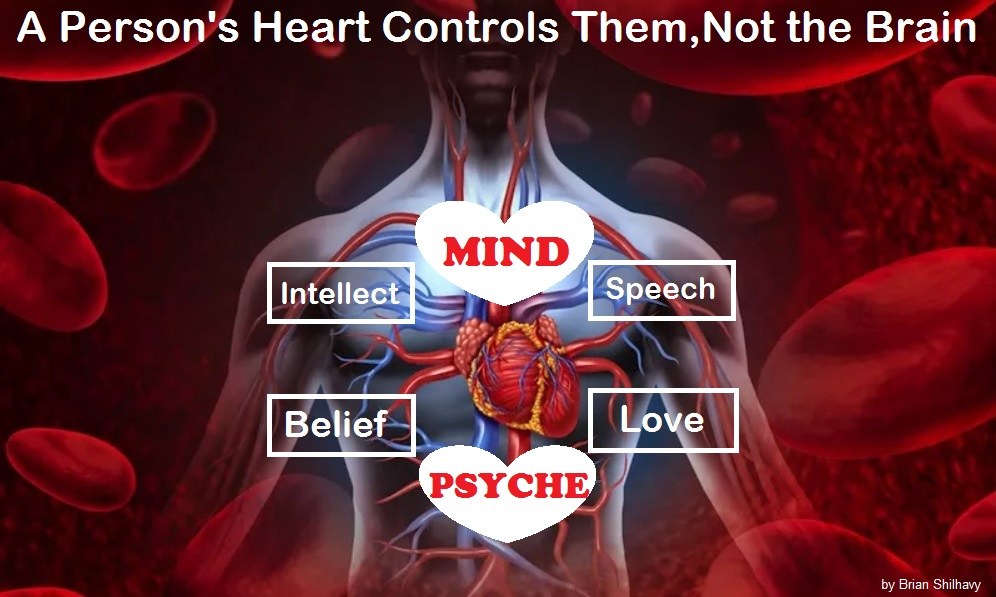
The Brain Myth: Your Intellect and Thoughts Originate in Your Heart, Not Your Brain [14]
 [14]
[14]
Is God’s Patience About to Run Out on the United States? [15]
 [15]
[15]
Second Edition of eBook Released: The Concept of the American Christian Family is a Myth and is NOT Found Anywhere in the Bible – by Brian Shilhavy [16]
 [16]
[16]
FREE eBook! Restoring the Foundation of New Testament Faith in Jesus Christ – by Brian Shilhavy [17]
 [17]
[17]
KABBALAH: The Anti-Christ Religion of Satan that Controls the World Today [18]
 [18]
[18]
Exposing the Christian Zionism Cult [19]
 [19]
[19]
The Bewitching of America with the Evil Eye and the Mark of the Beast [20]
 [20]
[20]
Jesus Christ’s Opposition to the Jewish State: Lessons for Today [21]
 [21]
[21]
Identifying the Luciferian Globalists Implementing the New World Order – Who are the “Jews”? [22]
 [22]
[22]
The Seal and Mark of God is Far More Important than the “Mark of the Beast” – Are You Prepared for What’s Coming? [23]
 [23]
[23]
The Satanic Roots to Modern Medicine – The Image of the Beast? [24]
 [24]
[24]
Medicine: Idolatry in the Twenty First Century – 10-Year-Old Article More Relevant Today than the Day it was Written [25]
 [25]
[25]
 [26]
[26]
Having problems receiving our emails? See:
 [27]
[27]
How to Beat Internet Censorship and Create Your Own Newsfeed [27]
We Are Now on Telegram [28]. Video channels at Bitchute [29], and Odysee [30].
If our website is seized and shut down, find us on Telegram [28], as well as Bitchute [29] and Odysee [30] for further instructions about where to find us.
If you use the TOR Onion browser [31], here are the links and corresponding URLs to use in the TOR browser [31] to find us on the Dark Web: Health Impact News [32], Vaccine Impact [33], Medical Kidnap [34], Created4Health [35], CoconutOil.com [36].